

Spirits of the Earth: A Study of Animism
Course IV of the Certified Godhunter Series
Animism shifts the location of the divine from a transcendent realm to the physical environment, viewing natural objects as containing a spiritual essence. Rather than a single God, Animism posits a pluralistic world populated by a society of “other-than-human persons”. This course explores geological and hydrological nature spirits, the anthropological shift from “Old” to “New Animism,” and the ethics of ritual diplomacy. Students will compare these indigenous ontologies and ecological perspectives against the framework of Classical Theism.
Each of our courses is divided into 10 classes corresponding to the 10 chapters of the textbook assigned to the course. Each class has four essay questions.
Take This Course All Fourteen Courses

Meet Your AI Tutor: Prof. Dr. Nemo LXON
Your 24/7 Socratic Guide Through the Crucible
The Godhunter Academy does not simply feed you information; we demand that you defend it. To aid you in this rigorous pursuit, you will be guided by Prof. Dr. Nemo LXON—a proprietary, highly advanced AI theological tutor.
Programmed with a library of classical apologetics, historical data, and philosophical frameworks, Professor Nemo is not a passive search engine. He is a tireless sparring partner embedded directly into this syllabus, ready to challenge your premises, refine your arguments, and forge you into a Certified Godhunter.
Spirits of the Earth: A Study of Animism and Immanent Spirits: The 10-Class Syllabus
Chapter 1 Core Definition – The Locus of the Divine
Discover how Animism – spirits of the earth changes the “locus” of the divine from a transcendent realm to the physical environment. You will learn to distinguish between the theological concept of Omnipresence and the animistic view of Immanence, where objects possess their own “interiority” or inner soul.
Chapter 2 Nature Spirits – The “Living” Landscape
Examine the belief that geological matter, rivers, and animals are distinct objects containing spiritual essences. We contrast this with the Biblical view where creation praises the Architect but does not possess independent divinity.
Chapter 3 Pluralistically Immanent – The Society of Spirits
Explore a pluralistic world populated by a society of “other-than-human persons”. You will study the concept of “mimesis” and the spiritual danger of adopting an animal’s perspective in a “crowded room” of spiritual entities.
Chapter 4 “Mother Nature” – The Environment as Parent
Analyze the relational epistemology where the environment is viewed as a relating “parent” rather than a resource. We explore the danger of “Monistic Speculation,” where identifying God entirely with the world subjects the divine to the world’s decay.
Chapter 5 Historical Context – From Belief to Relation
Trace the evolution of anthropological thought from E.B. Tylor’s “Old Animism,” which viewed the worldview as a mistaken belief, to the “New Animism,” which reframes it as a sophisticated social logic.
Chapter 6 The Concept of Anima – Breath and Interiority
Define the Latin Anima as the shared “interiority” or personhood existing inside different physical bodies. We will contrast the animistic “life-force” with the Classical Theist concept of the “Living God”.
Chapter 7 Animism vs. Pantheism – The Distinct Many vs. The Unified All
Learn to definitively distinguish between these two worldviews. Animism asserts that spiritual essences are distinct and localized, whereas Pantheism asserts that the Universe and God are identical.
Chapter 8 Traditional Belief Systems – Case Studies in Ontology
Review specific case studies, including A.I. Hallowell’s study of the Ojibwa, the relational epistemology of the Nayaka people, and the mimesis utilized by Siberian Yukaghir hunters.
Chapter 9 Ritual and Respect – The Ethics of Interaction
Understand why the proper animistic response to the divine is not worship, but “manners” and diplomacy. We examine transactional rituals and the concept of “immanent agency” in natural shrines.
Chapter 10 Synthesis – Ecology and the Enchanted World
Investigate the modern resurgence of Animism through the ecological movement. We evaluate the final verdict on the definition of “Life,” comparing the animist’s inherently spirited world to the Classical Theist’s world sustained by the Living God.
Test Your Investigative Instincts
Test your current reasoning with these questions:
1. The Theological Question: How does the animistic concept of “Immanence” differ fundamentally from the Classical Theist concept of “Omnipresence”? (Answer Hint: In Omnipresence, God is present as a sustainer, but the physical object does not have a personality; in Animism, the object possesses its own inner soul and is treated as a “Thou” or a person.)
2. The Anthropological Question: What is the critical difference between E.B. Tylor’s “Old Animism” and the “New Animism” embraced by modern anthropology? (Answer Hint: The “Old Animism” viewed it as a mistaken belief or failed science, while the “New Animism” reframes it as a valid relational epistemology and a sophisticated social logic for knowing the world.)
3. The Worldview Question: Why is it a philosophical error to conflate Animism with Pantheism? (Answer Hint: Pantheism is a Monistic belief that the entire universe and God are identically one substance, whereas Animism is Pluralistic, believing in a “crowded room” of distinct, localized spiritual neighbors.)
Why did we use this image for this course?
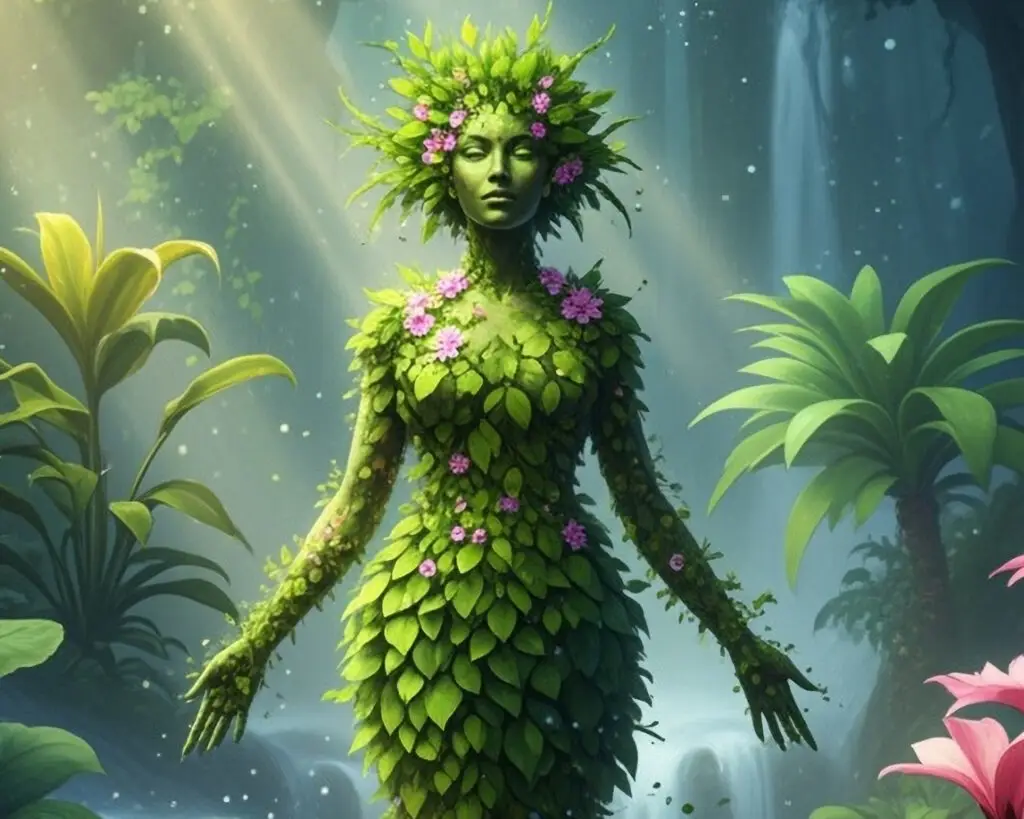
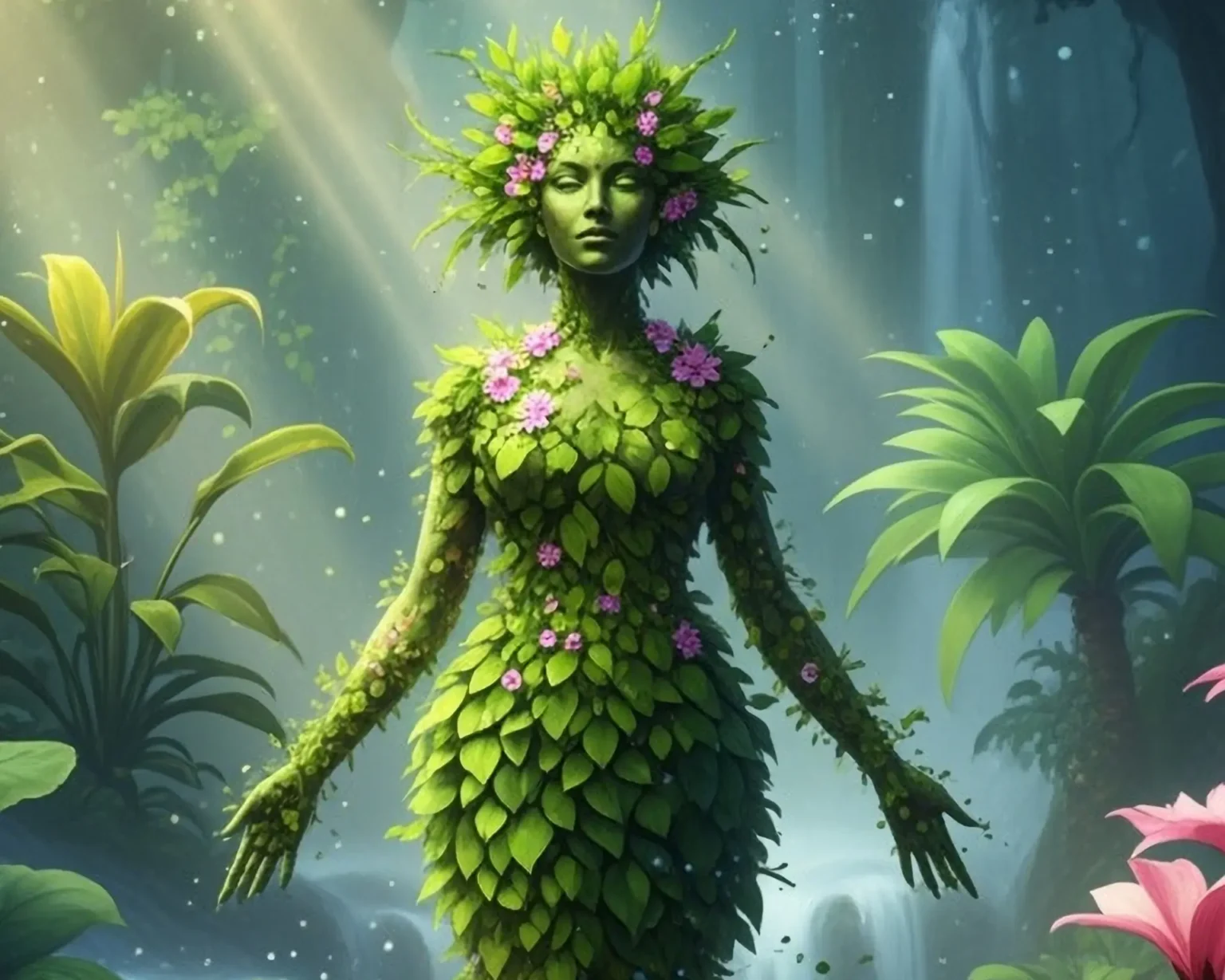
Mother Earth spiritually symbolizes the Earth as a living, nurturing entity that provides life, nourishment, and protection. It represents the sacred interconnectedness of all beings, emphasizing respect, stewardship, and the divine feminine capacity to create, sustain, and regenerate life. This perspective fosters environmental awareness and reverence for the planet’s elements.
“… Saint Francis of Assisi reminds us that our common home is like a sister with whom we share our life and a beautiful mother who opens her arms to embrace us. Nature cannot be regarded as something separate from ourselves or as a mere setting in which we live. We are part of nature, included in it and thus in constant interaction with it. …. Praise be to you, my Lord, through our Sister, Mother Earth, who sustains and governs us, and who produces various fruit with coloured flowers and herbs”. ” Pope Francis, Laudato Si, #139