

Pantheism: God is the World
Course XII of the Certified Godhunter Series
Welcome to Pantheism: God is the World. This course focuses on the theory that God and the universe are identical, equating divinity with the totality of nature. Unlike approaches that posit a Creator outside of creation, Pantheism argues that the Creator is the creation. Students will explore the implications of “Strict Immanence,” trace the lineage of this thought from ancient Stoicism to the philosophy of Baruch Spinoza, and understand how this worldview reshapes ethics, prayer, and our relationship with the environment.
Each of our courses is divided into 10 classes corresponding to the 10 chapters of the textbook assigned to the course. Each class has four essay questions.
Take This Course All Fourteen Courses

Meet Your AI Tutor: Prof. Dr. Nemo LXON
Your 24/7 Socratic Guide Through the Crucible
The Godhunter Academy does not simply feed you information; we demand that you defend it. To aid you in this rigorous pursuit, you will be guided by Prof. Dr. Nemo LXON—a proprietary, highly advanced AI theological tutor.
Programmed with a library of classical apologetics, historical data, and philosophical frameworks, Professor Nemo is not a passive search engine. He is a tireless sparring partner embedded directly into this syllabus, ready to challenge your premises, refine your arguments, and forge you into a Certified Godhunter.
Pantheism: God is the World: The 10-Chapter Syllabus
Chapter 1 God and the Universe are Identical
Define the “Identity Thesis”: God and the Universe are one and the same thing. You will explore the “Paint” analogy—just as a painting is made entirely of paint, the universe is made entirely of God, leaving no room for the “supernatural” outside of nature.
Chapter 2 The Nature of God
Understand “Strict Immanence.” In Pantheism, the line between Creator and Creature is erased; God does not transcend reality, but remains entirely within the boundaries of the physical world.
Chapter 3 Implications of Identity
Explore the perceptual shift required when looking at the physical world. If God is the whole, individual separation is an illusion, and the mundane (dirt, light, biology) becomes holy, making science and astronomy forms of worship.
Chapter 4 The Non-Personal Divine
Analyze a God with no human ego, personality, or specific will. You will learn why intercessory prayer is considered meaningless in this system, replaced instead by meditation and attunement to the indifferent realities of nature.
Chapter 5 Baruch Spinoza
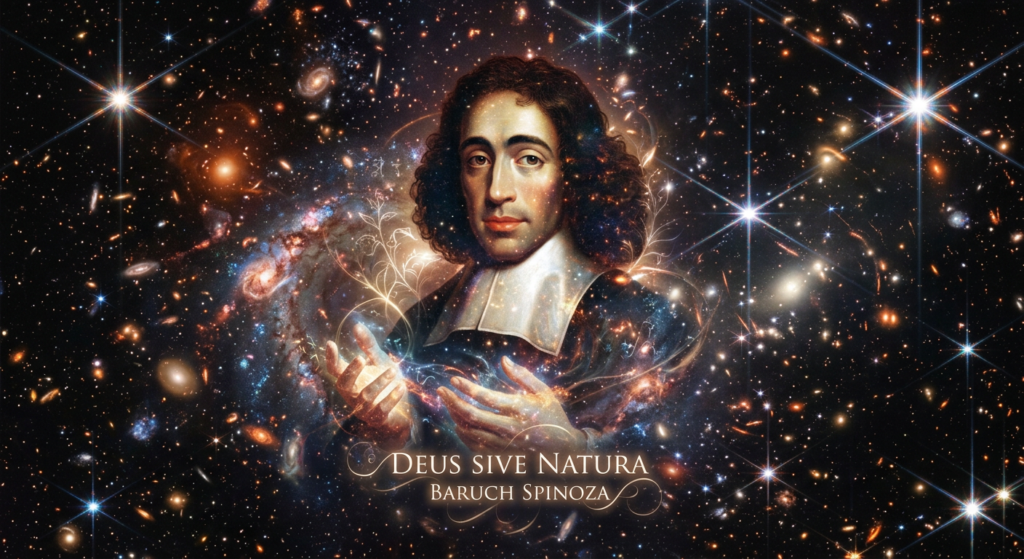
Study the central intellectual figure of modern Pantheism. We examine his famous phrase Deus sive Natura (“God or Nature”), his theory of Substance Monism, and the concept of the “Intellectual Love of God.”
Chapter 6 Stoicism
Trace Pantheism back to antiquity. We explore the Stoic belief in a universe permeated by a “Divine Fire” and governed by the Logos (Reason), leading to the ethic of Amor Fati (Love of Fate).
Chapter 7 Daoism
Examine the Eastern concept of the Dao (The Way) as an impersonal, flowing force. We discuss metaphors like the “Uncarved Block” and the practice of Wu Wei (Effortless Action) to align with nature.
Chapter 8 Pantheism vs. Monism
Distinguish between these related but distinct categories. While Monism argues “Reality is One,” Pantheism specifically argues “That One is the Concrete Physical Universe,” rejecting the idea that the physical world is an illusion.
Chapter 9 Pantheism vs. Panentheism
Master the most crucial distinction in the course: Identity vs. Inclusion. You will learn why Pantheism equates God with the world (Identity), while Panentheism places the world inside a God who extends beyond it (Inclusion).
Chapter 10 Ecology and Modern Applications
Investigate “Scientific Pantheism” and its role in Deep Ecology. We discuss the shift from an Anthropocentric to a Bio-centric ethic, where humanity is viewed not as the ruler of nature, but as a part of the divine web.
Test Your Investigative Instincts
Before you commit to the hunt, test your current reasoning against the Academy’s philosophical curriculum.
1. The Definitional Question: What is the “Identity Thesis” in Pantheistic thought? (Answer Hint: It is the foundational belief that God and the Universe are one and the exact same thing; “God” is simply another name for the totality of nature and reality.)
2. The Relational Question: Why is traditional intercessory prayer (asking God for favors or miracles) considered meaningless in Pantheism? (Answer Hint: Because the Pantheistic God is not a person with an ego or will, but rather the sum total of physical laws and reality, one cannot petition gravity or the universe to suspend its own laws.)
3. The Theological Comparison Question: What is the crucial linguistic and philosophical difference between Pantheism and Panentheism? (Answer Hint: Pantheism is the belief of “Identity” (God is the world), while Panentheism adds the “en” (in), creating a theology of “Inclusion” (The world is in God, but God extends beyond it).