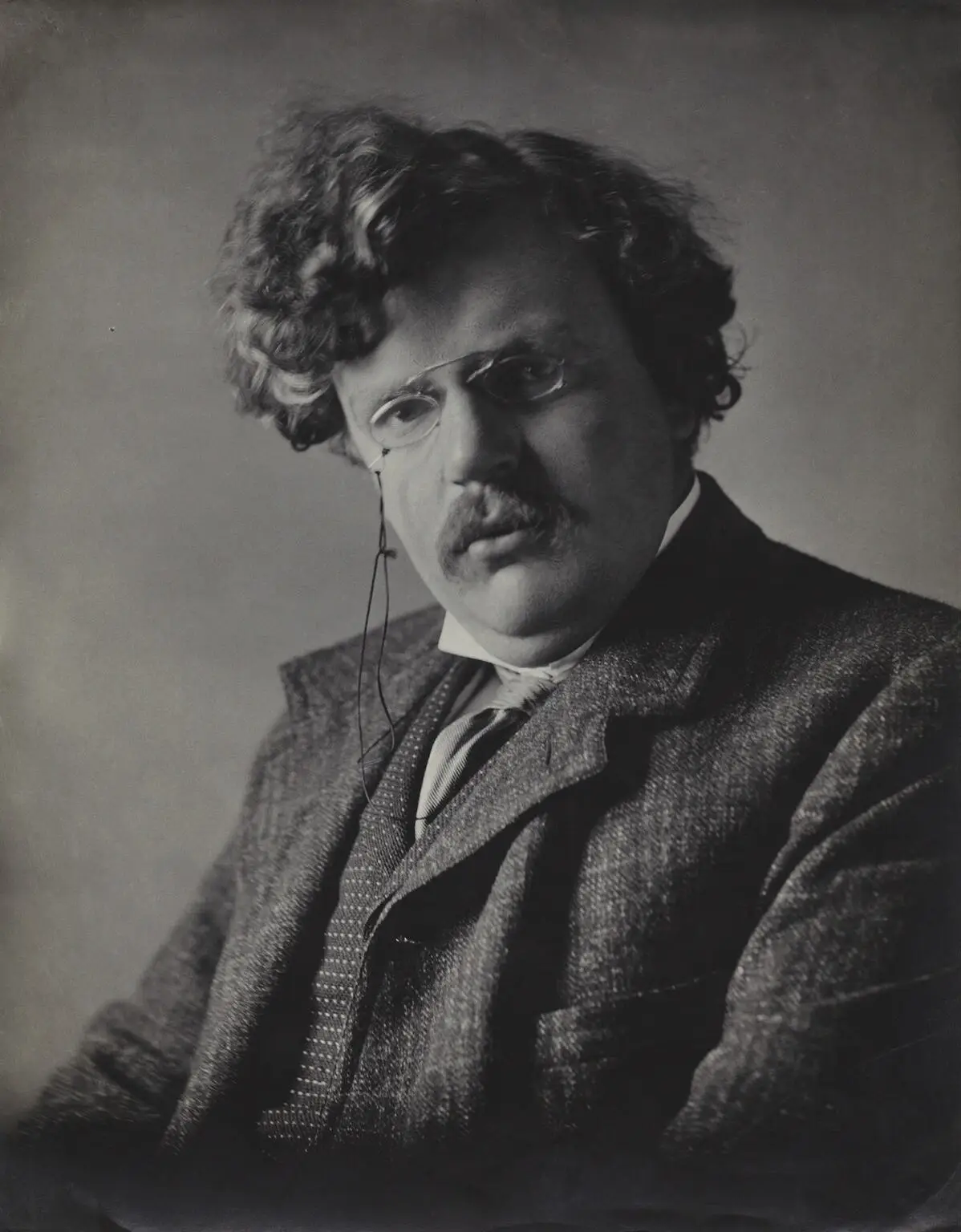
G.K. Chesterton, Orthodoxy 1908
While The Everlasting Man provides a macro-historical defense of the faith, “Orthodoxy” (1908) is arguably Chesterton’s most intimate and intellectually vibrant work. It serves as the philosophical “prequel” to his later historical analysis, focusing on the internal logic of the Christian faith.
Summary of the Book:
Chesterton famously described Orthodoxy as a “spiritual autobiography.” Rather than a dry list of doctrines, the book is a narrative of a man who sets out to invent his own philosophy, only to discover that Christianity had already discovered it centuries prior. He likens himself to an English yachtsman who gets slightly lost and “discovers” England, thinking it is a new island in the South Seas.
The book is structured around several key philosophical “paradoxes” that Chesterton believes only Christianity can resolve:
- The Maniac: He argues that the modern materialist is like a madman—not because he lacks logic, but because he has nothing but logic, which creates a small, suffocating world.
- The Ethics of Elfland: He defends the “supernatural” by suggesting that the repetitive laws of nature (like the sun rising every day) are not mechanical, but are the result of God’s “exultant” theatrical encore.
- The Flag of the World: He posits that one must love the world enough to want to change it, but also realize it is “fallen”—a balance he finds only in the Christian concept of being “in the world but not of it.”
Historical Significance:
Orthodoxy is considered one of the most influential works of Christian apologetics in the 20th century. It shifted the tone of religious defense from the defensive and somber to the joyful and adventurous. It remains a primary text for those studying the intersection of faith, reason, and the “romance” of religion.
Author Background: G.K. Chesterton (1874–1936)
To understand Orthodoxy, one must understand the man behind the “Sword of Wit.” At the time of this publication, Chesterton was a young, rising journalist in London.
- The Journalist-Theologian: Unlike many of his contemporaries who wrote from ivory towers, Chesterton wrote for the common man in newspapers. This gave his theology a grounded, populist energy.
- The Defender of the Ordinary: He was deeply concerned with the “common man” and the “common sense” of the ages. He believed that the average person’s instinct toward wonder was more accurate than the cynicism of the elite intelligentsia.
- The Transition to Rome: While he wrote Orthodoxy while still an Anglican, the book captures the trajectory that would eventually lead him to the Roman Catholic Church in 1922. He spent his life arguing that “the Church is the only thing that saves a man from the degrading slavery of being a child of his age.”