


Looking for Footprints: A Forensic Approach to Finding God
Course I of the Certified Godhunter Series
Rather than “blind faith”, this course teaches an evidential approach by exploring ways to search for God as a rigorous forensic investigation. Before looking outward, investigators will first confront the cognitive, cultural, and theological biases that deeply distort our perception of a Creator. Students will then examine the universe for detectable “fingerprints” by exploring specific hunting grounds, including scientific teleology, prophetic fulfillment, and historical forensics. Rather than teaching rigid dogma, this class provides the background necessary for both believers and skeptics to examine the tangible evidence and make up their own minds. After all the tools, books, and tracking, the final step of the hunt is the willingness to be found.
Each of our courses is divided into 10 classes corresponding to the 10 chapters of the textbook assigned to the course. Each class has four essay questions.
Take This Course All Fourteen Courses
Meet Your AI Tutor: Prof. Dr. Nemo LXON
Your 24/7 Socratic Guide Through the Crucible
The Godhunter Academy does not simply feed you information; we demand that you defend it. To aid you in this rigorous pursuit, you will be guided by Prof. Dr. Nemo LXON—a proprietary, highly advanced AI theological tutor.
Programmed with a library of classical apologetics, historical data, and philosophical frameworks, Professor Nemo is not a passive search engine. He is a tireless sparring partner embedded directly into this syllabus, ready to challenge your premises, refine your arguments, and forge you into a Certified Godhunter.
Looking for Footprints: The 10-Class Syllabus
Chapter 1 Confront Biases and Presuppositions
Before examining external evidence, we must examine the investigator. You will confront the cognitive and cultural lenses that distort our mental images of the divine, including Anthropomorphism, the Just-World Hypothesis, and the “God of the Gaps” fallacy.
Chapter 2 Define What You Are Seeking
Before the hunt begins, we must define the quarry. We categorize the different concepts of God—from a Personal Deity to a Universal Consciousness—and explore the “Infinite Gap” of divine communication through concepts like Dabar and Logos.
Chapter 3 Study Prior Hunts
Review the “field notes” of humanity’s greatest minds. We treat the accounts of prior seekers—from intellectuals like C.S. Lewis to scientists like Francis Collins and struggling finders like Mother Teresa—as case studies in forensic theology.
Chapter 4 Read Philosophical Arguments
Enter the courtroom of philosophy. We test classical arguments—including the Cosmological (First Cause), Teleological (Design), Moral, and Ontological arguments—to see if they provide a rational foundation for a Creator.
Chapter 5 Examine Prior Accounts
Evaluate historical “witness testimony”. We cross-examine the dossiers of those who claimed divinity, scriptural witnesses, mystics, and religious founders to distinguish between hallucination, political ambition, and true theophany.
Chapter 6 Examine the Universe
Treat the physical cosmos as the primary crime scene. We apply modern cosmology and astrophysics to analyze the “ballistics” of the Big Bang, the precise fine-tuning of physical laws, and the mathematical intelligibility of reality.
Chapter 7 Study Consciousness and Moral Intuition
Turn the magnifying glass inward. We test the hypothesis that human consciousness, objective moral intuition, and reason itself are not biological tricks, but signal receivers pointing to a Moral Lawgiver and an Infinite Reason.
Chapter 8 Conduct Inner Investigations
Move from the library to the laboratory. You will execute practical relational protocols, including the “Skeptic’s Prayer,” the “Live As If” method, and the “Juror’s Review,” to test the theistic hypothesis in the real world.
Chapter 9 Analyze Any Change in Viewpoints
Conduct a post-mortem on the investigation. You will evaluate your initial biases against the forensic evidence gathered and synthesize the physical clues with your moral instincts.
Chapter 10 Decide Whether to Continue to Hunt
Make a decision regarding your trajectory. Whether you conclude the case is closed, remain an intrigued agnostic, or transition into a found believer, this chapter guides your next steps
Test Your Investigative Instincts
Before you commit to a Forensic Approach to Finding God, test your current reasoning against the Academy’s curriculum.
1. The Cognitive Question: What is the “God of the Gaps” bias, and why is it detrimental to a robust forensic investigation? (Answer Hint: It shrinks God into a mere placeholder for things science cannot yet explain, creating a setup where scientific advancement automatically diminishes faith.)
2. The Astrophysics Question: When examining the cosmic crime scene, how does the “Fine-Tuning” of physics challenge the hypothesis that the universe is a purely random accident? (Answer Hint: The fundamental laws of physics are balanced on a razor’s edge; the mathematical probability of getting a life-permitting universe by pure chance is effectively zero, pointing logically toward design.)
3. The Relational Question: In Chapter 8’s “Skeptic’s Prayer” experiment, what is the single most important variable required for the test to yield valid data? (Answer Hint: True Openness—the investigator must possess a genuine willingness to change their life and thinking if they actually receive an answer.)
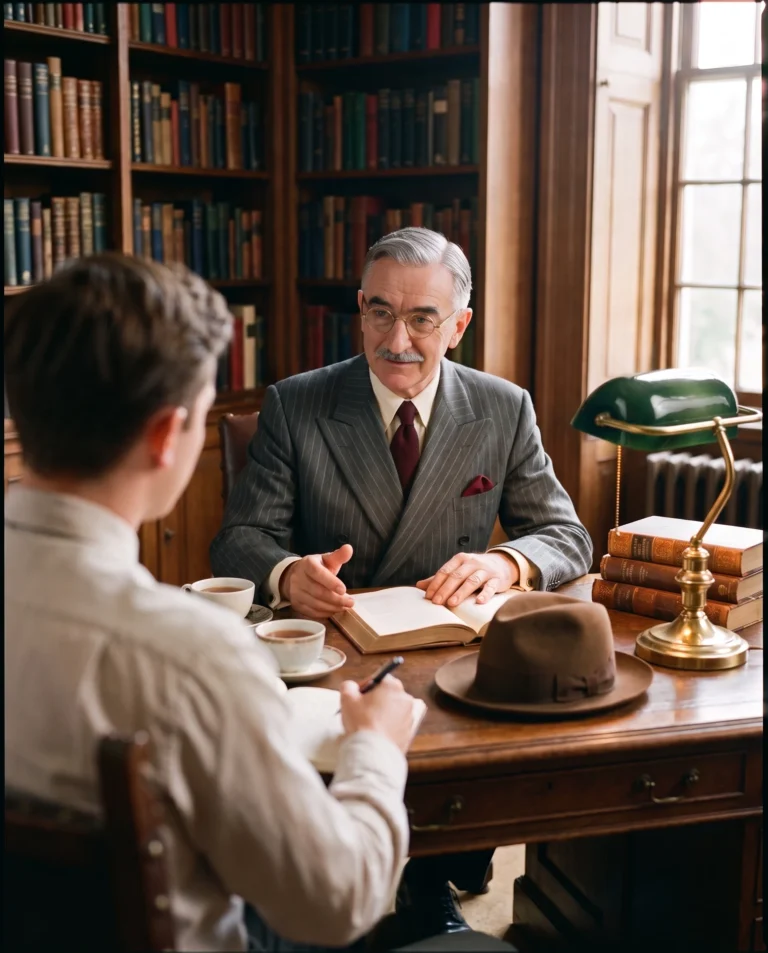
Why did we use this image for this course?
This is an AI-generated image of a scholar who has spent his life exploring and reading, looking for God. He has been all over the world investigating with a forensic approach to finding God. He cannot find God. He finally realizes that a finite mortal being cannot find God. God must find him if the mortal is willing to receive him. The light coming through the window represents a source of information from outside the scholar, one he can receive but cannot create.