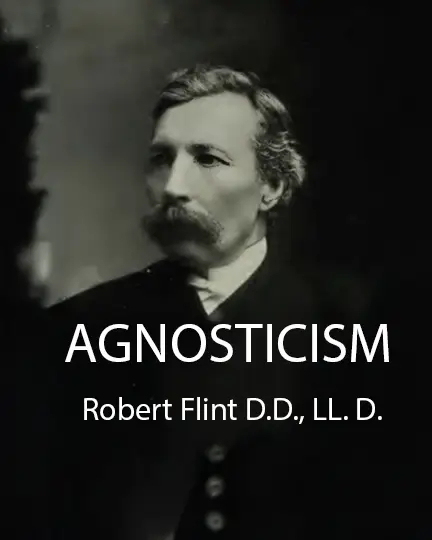
Flint, Robert. Agnosticism. Edinburgh: William Blackwood and Sons, 1903
In Agnosticism (1903), Robert Flint provides one of the most exhaustive philosophical and theological examinations of the term ever written. Emerging from his Croall Lectures, the work is less a dismissal of doubt and more a rigorous attempt to categorize and critique the boundaries of human knowledge.
Here is a summary of the core arguments and themes found in the text:
- Defining Agnosticism: Knowledge vs. Belief
Flint’s primary contribution is his insistence that agnosticism is an epistemological position (concerning knowledge) rather than a doxastic one (concerning belief).
- The Definition: He defines agnosticism as the theory that “the existence of anything beyond the phenomena of sense and consciousness is unknown and unknowable.”
- The “Unknown” vs. the “Unknowable”: Flint distinguishes between simple ignorance (not knowing something yet) and formal agnosticism (asserting that something cannot be known by the human mind).
- The Relationship Between Agnosticism and Atheism
One of the most cited sections of the book involves Flint’s rejection of the idea that agnosticism and atheism are mutually exclusive.
- Overlap: He argues that an agnostic can be an atheist (if they lack belief in God because they believe God is unknowable) or even a theist (if they believe in God via faith despite claiming God is philosophically unknowable).
- The Distinction: Atheism is a position on the existence of God; Agnosticism is a position on the knowledge of God.
- Historical and Philosophical Critique
Flint meticulously traces the “errors” of agnosticism through history, critiquing major thinkers who paved the way for the movement:
- Hume and Kant: While respecting their genius, Flint argues that Hume’s skepticism and Kant’s “phenomenalism” (the idea that we only know appearances, not “things-in-themselves”) laid a faulty foundation that leads to intellectual paralysis.
- Herbert Spencer: Flint offers a sharp critique of Spencer’s “The Unknowable.” He argues that to claim something is “unknowable” requires a degree of knowledge about it—creating a logical paradox.
- Varieties of Agnosticism
Flint categorizes the movement into several types to better dismantle them:
- Total Agnosticism: Radical skepticism that doubts everything, including the senses (which Flint argues is self-refuting).
- Partial Agnosticism: Skepticism directed only at specific areas, like metaphysics or theology.
- Religious Agnosticism: The view (held even by some theologians like Henry Mansel) that God’s nature is so transcendent that human reason cannot grasp it, leaving only “regulative” truth.
- The Defense of Theism
As a theologian, Flint’s ultimate goal is to prove that Theism is a “legitimate” exercise of reason. * He argues that the human mind is naturally constituted to perceive a “First Cause” and “Moral Governor.”
- He maintains that if we can know anything at all (like the laws of science), we have the capacity to know the fundamental truths of religion. To deny one is, in his view, to eventually deny the other.