Panentheism: The World in God
Course X of the Certified Godhunter Series
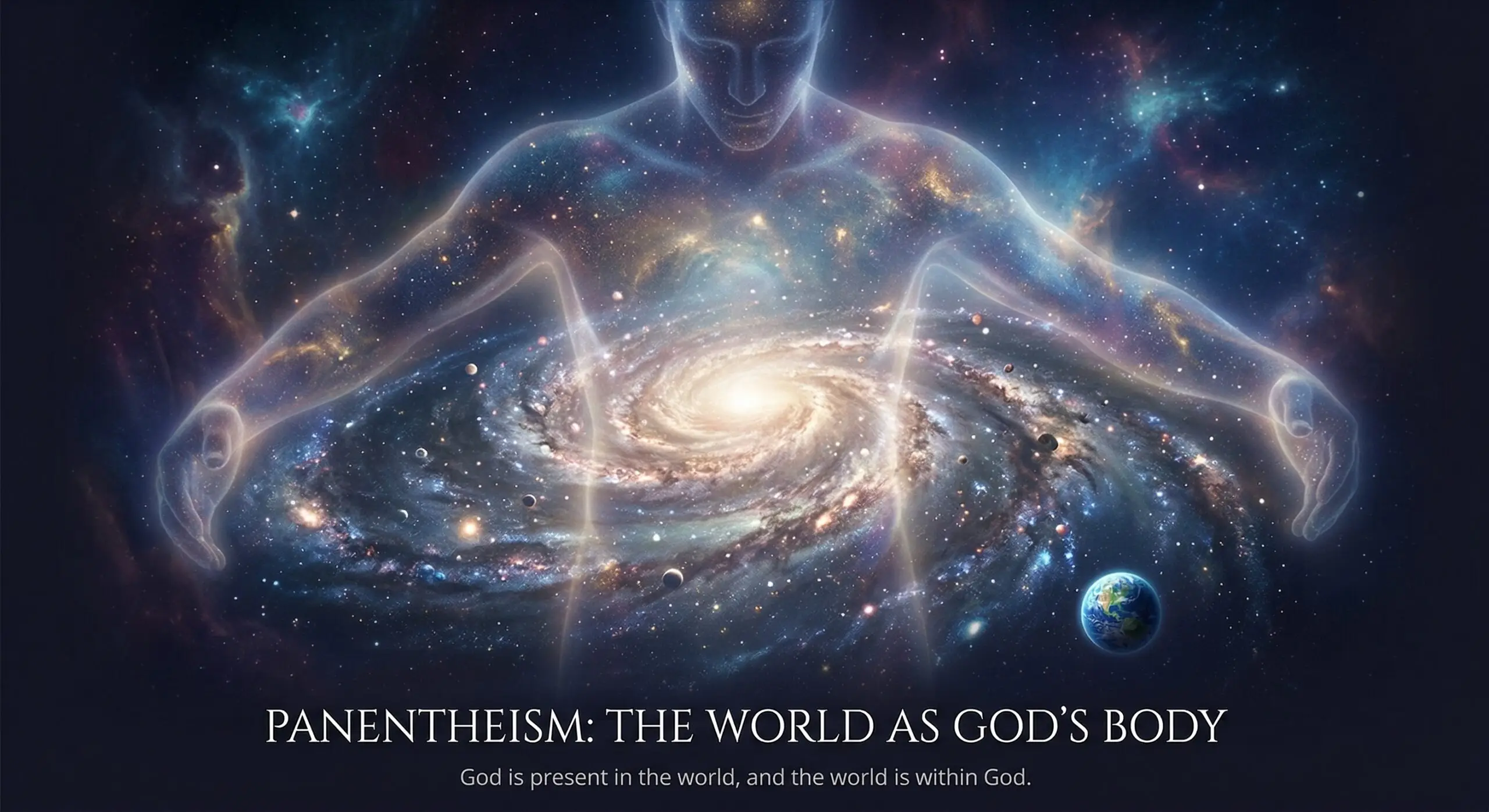
Welcome to Panentheism: The World in God. This course explores the inclusive theological view where the world exists within God, but God extends beyond the physical universe. Unlike Pantheism, which equates God with the world, or Deism, which separates God from the world, Panentheism argues for a relationship of containment and transcendence. Students will rely on key metaphors like the sponge in the ocean to visualize this relationship and trace this thread through Sikhism, Kabbalah, and Process Theology.
Each of our courses are divided into 10 classes corresponding to the 10 chapters of the textbook assigned to the course. Each class has four lessons.Each of our courses are divided into 10 classes corresponding to the 10 chapters of the textbook assigned to the course. Each class has four lessons.

Meet Your AI Tutor: Prof. Dr. Nemo LXON
Your 24/7 Socratic Guide Through the Crucible
The Godhunting Academy does not simply feed you information; we demand that you defend it. To aid you in this rigorous pursuit, you will be guided by Doctor Nemo LXON—a proprietary, highly advanced AI theological tutor.
Programmed with a vast library of classical apologetics, historical data, and philosophical frameworks, Doctor Nemo is not a passive search engine. He is a tireless sparring partner embedded directly into this syllabus, ready to challenge your premises, refine your arguments, and forge you into a Certified Godhunter™.
Panentheism: The World in God: The 10-Class Syllabus
Chapter 1: The Core Definition Define the core thesis that the world is in God, but God is also more than the world. You will learn to position Panentheism as the “Middle Way” between Classical Theism and Pantheism.
Chapter 2: The Inclusive Relationship Explore visual analogies for this inclusive relationship, such as the sponge completely saturated by the ocean , or the art gallery containing the painting while remaining larger than the art itself.
Chapter 3: Arguments and Proofs Investigate philosophical arguments for this view, including the logic of infinity, causality, and scientific resonances like Field Theory and Quantum Entanglement.
Chapter 4: What Kind of God? Examine the concept of a sympathetic God who literally feels the suffering of the world because the world is internal to God. We will introduce the concept of the “Dipolar God”.
Chapter 5: Sikhism Survey Sikhism as a major religious expression of Panentheism, studying the concept of Ik Onkar (One Supreme Reality) and the rejection of duality between God and the world.
Chapter 6: Mystical Traditions Analyze mystical traditions across faiths, including the Kabbalistic concept of Tzimtzum (Contraction) and Christian mystic Pierre Teilhard de Chardin’s view of the “Divine Milieu”.
Chapter 7: The Process Theism Sub-category Define Process Theology (based on A.N. Whitehead) as the philosophically rigorous wing of Panentheism, where God persuades rather than coerces the world in a dynamic feedback loop.
Chapter 8: Panentheism and Divine Presence Reframe the concept of Omnipresence, viewing space itself as an attribute of the Divine , and explore the deep environmental ethics required to live in a “Sacramental Universe”.
Chapter 9: Distinguishing Pantheism Distinguish this worldview from Pantheism by focusing on Identity (Pantheism) versus Containment (Panentheism) to avoid the most common conflation errors in this theological field.
Chapter 10: Synthesis Synthesize how Panentheism provides a spiritual foundation for “Deep Ecology” and examine its potential as the future of theology in an evolving, scientific age.
Test Your Investigative Instincts
Test your reasoning against the Academy’s curriculum.
1. The Definitional Question: How does the literal translation of “Panentheism” differ fundamentally from “Pantheism”?
(Answer Hint: Panentheism translates to “All-in-God,” emphasizing a relationship of containment and transcendence, whereas Pantheism translates to “All-is-God,” emphasizing sheer identity where God and the universe are the exact same thing).
2. The Metaphor Question: In the “Sponge in the Ocean” analogy, what specific theological point does the ocean represent?
(Answer Hint: The ocean represents that God completely saturates and fills the physical universe (the sponge), but God also extends infinitely far beyond it, preserving divine transcendence.
3. The Theological Concept Question: What is the definition of the “Dipolar God” in Panentheistic thought?
(Answer Hint: It is the concept that God has two poles: a Primordial Pole representing God’s eternal, unchanging potential, and a Consequent Pole representing God’s changing, reactive experience of the evolving world).