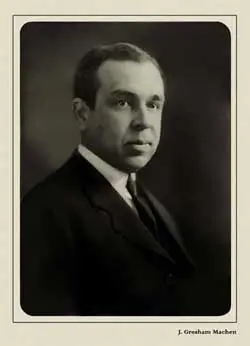
J. Gresham Machen, Christianity and Liberalism, 1923
Summary of the Book:
The central and most provocative thesis of Machen’s work is that “Liberalism” (modernist theology) is not a “variety” of Christianity, but is, in fact, an entirely different religion—one that shares some terminology with Christianity but remains fundamentally incompatible with its core tenets.
Machen structures his argument by comparing historic Christianity and Liberalism across several key categories:
Doctrine: He argues that Christianity is founded on historical facts (the life, death, and resurrection of Jesus), whereas Liberalism views doctrine merely as the changing symbolic expression of religious feeling.
God and Man: Machen posits that Liberalism loses the “transcendence” of God by overemphasizing His “immanence,” resulting in a sentimental view of human nature that ignores the reality of sin.
The Bible: He defends the Bible as a record of unique, supernatural revelation, contrasting it with the Liberal view of the Bible as a record of human religious experience.
Salvation: He argues that Liberalism turns Jesus into a mere “example” for living, while Christianity views Him as the “Saviour” whose substitutionary atonement is the only remedy for sin.
Historical Significance:
The book was a defining document during the “Fundamentalist-Modernist Controversy” of the 1920s. It is highly regarded even by secular historians for its logical consistency and intellectual honesty. Unlike some of his contemporaries who relied on emotional appeals, Machen used rigorous scholarship to argue that the church must be honest about its definitions.
Author Background: J. Gresham Machen (1881–1937)
John Gresham Machen was perhaps the most formidable intellectual defender of Reformed orthodoxy in the early 20th century.
Academic Pedigree: Machen was a man of immense learning. He studied at Johns Hopkins, Princeton University, and Princeton Theological Seminary, followed by further studies in Germany under leading European scholars.
The Princeton Legacy: He served as a professor of New Testament at Princeton Theological Seminary for many years. However, when he felt the institution was drifting toward theological pluralism, he led a high-profile exit to found Westminster Theological Seminary in 1929.
A “Libertarian” Conservative: Interestingly, while Machen was a theological conservative, he was also a staunch advocate for civil liberties and the separation of church and state. He famously opposed the forced consolidation of schools and government overreach, arguing that true faith must be voluntary and intellectually convinced.
The Linguistic Scholar: Beyond his polemical works, his textbook New Testament Greek for Beginners (1923) remained the standard text for seminary students for over half a century.